THE SYMBOLISM OF THE RABBIT
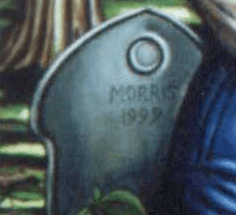
Given the symbolism of the rabbit – and what it represents – the tombstone, with the date and my name written on it cannot escape significance. Tie that in with the image of the reaper then it would seem there is an unspoken message in there – a metaphorical death, or at least a figurative passing away or moving on.
There is not much commentary in the Art Diary concerning Rabbit and given that was 25 years ago I can only speculate retrospectively on the thought processes which were going on at the time.
The main themes in the painting – as an artist, teacher and parent – concern the nature of childhood and the loss of innocence and corruption as adulthood approaches. I felt the need for there to be a narrative concerning these themes, and so the need for there to be a parable or cautionary tale behind the painting. I also wanted to create a more expansive work beyond head-and-shoulder portraits.
Inevitably, this led to a more complex composition. Perhaps inspired by reading countless Grimms fairly tales to my children, the painting is set in a moon-lit forest. How the rabbit-boy and boy-rabbit came to be is not known. What is evident is the danger they are in and it is the predatory nature of this danger that is unsettling. Is the snake poisonous? Was the arrow aimed at the boy rabbit with intent to maim? Is the Grim Reaper after them? And if he is, will he catch up? Are those evil sprites behind him? Have the trees in the forest come to life? Or Is it just in the imagination?
This experience resembles the perennial theme of the fairly tales where the unsuspecting waif wanders into the dangers of the primeval forest. Obstacles proliferate but they are overcome – either through some benevolent figure or by being bestowed with some magical power. Some unseen hand is offering protection and guiding their fortunes, and it occurs to me now – in retrospect – that perhaps that hand, at the time, was mine given what lies ahead for the rabbit boys in that landscape.
In both art and mythology the rabbit has been associated with the divinity of the moon and is seen to represent resurrection or rebirth. The rabbit has often been regarded as a symbol of immortality. In Alice in Wonderland, the white rabbit is synonymous with life transformation or the beginning of a new adventure. In this sense the rabbit can also symbolize a spiritual awakening.
In Jungian psychology, the process of personal growth and transformation is often symbolised by a journey. Drawing upon Greek mythology, the Nekyia provides a powerful metaphor also known as the night journey on the ocean, which entails an evocation of the dead in which the spirits are called upon to answer questions about the future. Jung adopted the Nekyia as a symbol of the journey of the psyche to find emotional maturity or enlightenment.
The good thing about the myth of the Nekyia is that the hero goes through challenges and trials during his night journey, but he returns to the light and emerges as a better person. So overall it is a positive experience.
This, of course, is not to be confused with the Katabasis – a descent into the underworld from which there is no return – and therefore an altogether heavier trip.
 DAVID Morris | Art